Case Study 05 · SaaS / AI Content
IntuitySync AI
AI-powered social media automation, posting, and analytics across all channels
Intro
Product: B2B SaaS, social media automation platform.
Industry: Marketing / Social Media
Location: United States
Product type: B2B SaaS, social media automation platform.
Target market: Agencies, social media managers, and marketing teams.
Role: Frontend lead, product UI, AI content pipeline integration, and responsive architecture.
What Made This a Good Bet
Marketing teams were spending hours per week on manual posting, caption writing, and performance tracking across channels.
Existing tools were either too simple or too expensive for growing agencies.
No single dashboard handled content creation, scheduling, analytics, and multi-channel publishing together.
Social media consistency directly impacts brand growth; gaps in posting cost reach and follower momentum.
AI-generated captions and images were available as point tools but not integrated into a unified workflow.
Early adopters needed a solution that reduced workload by at least 50% to justify switching costs.
What I Built
Delivered the full frontend MVP in 3 months as sole frontend lead.
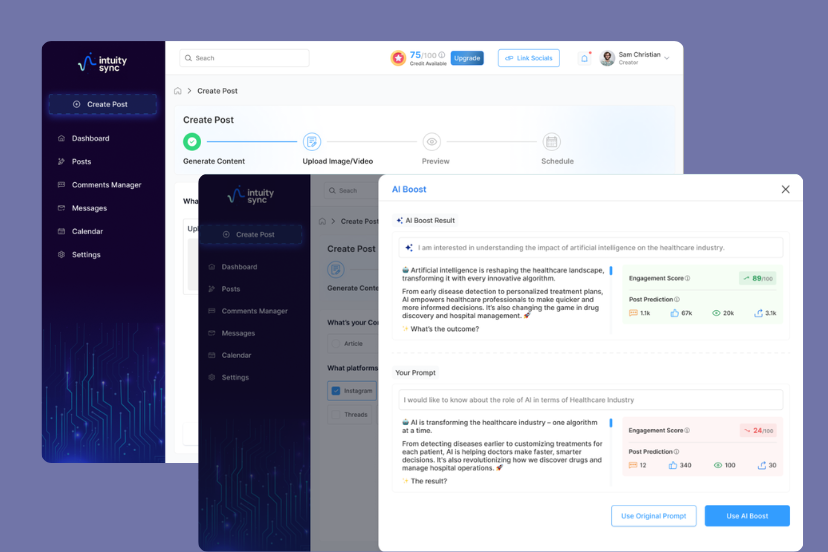
Built the AI content pipeline UI, including content brief inputs and AI-generated caption/image previews.
Implemented a responsive architecture that maintained a consistent UX across desktop, tablet, and mobile.
Integrated with the analytics and scheduling backend to surface post performance and best times.
Optimized component architecture to handle large content queues without UI degradation.
The Stack
Beyond The Headline Metrics
Full MVP delivered in 3 months as the sole frontend lead.
AI content pipeline cut manual creation workload by 60% for early users.
Responsive architecture improvements lifted user engagement metrics by 40%.
Successfully onboarded 50+ paying early adopters in the first quarter post-launch.