Case Study 02 · Healthcare AI
Healium CKD
CKD detection through AI-powered kidney ultrasound analysis
Intro
Client: Healium Intelliscan Corporation
Location: United States
Role: Lead Full-stack engineer responsible for AI pipeline, inference API, data architecture, and deployment.
What Made This a Good Bet
Chronic Kidney Disease (CKD) affects millions, but many cases are diagnosed too late for effective intervention.
Early-stage indicators are visible in ultrasound, but specialist interpretation is rarely available in primary care settings.
The project required an AI service that converts kidney ultrasound into structured findings for general practitioners.
Early intervention can significantly slow CKD progression and reduce the need for dialysis.
Nephrologist access was a critical bottleneck, with a very low specialist-to-patient ratio in the region.
General practitioners needed fast triage tools to decide referral urgency.
Delayed diagnosis contributed to a high rate of emergency admissions and late-stage dialysis starts.
What I Built
Implemented an upload-to-inference flow with Next.js, API Gateway, Lambda, and FastAPI.
Built image preprocessing for model consistency across different ultrasound hardware manufacturers.
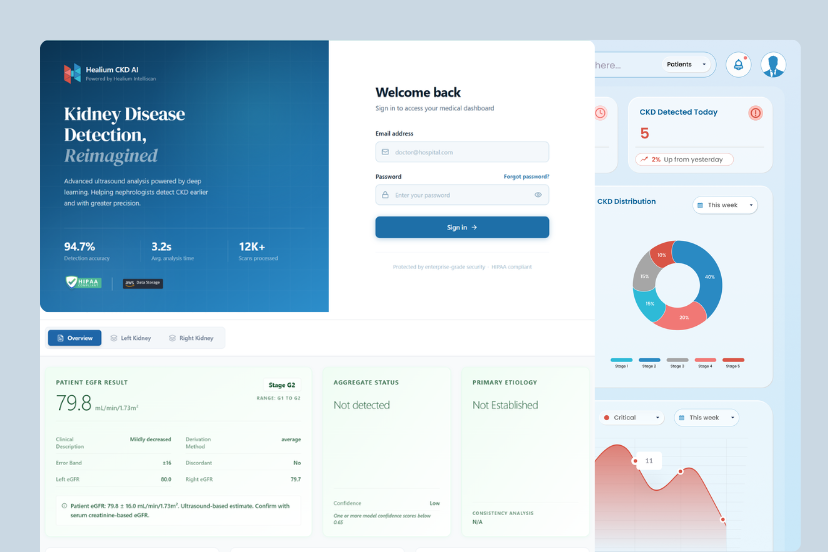
Returned structured outputs including automated findings, severity score, confidence, and recommended next action.
Stored reports in Supabase linked to patient records with strict clinic-level data isolation.
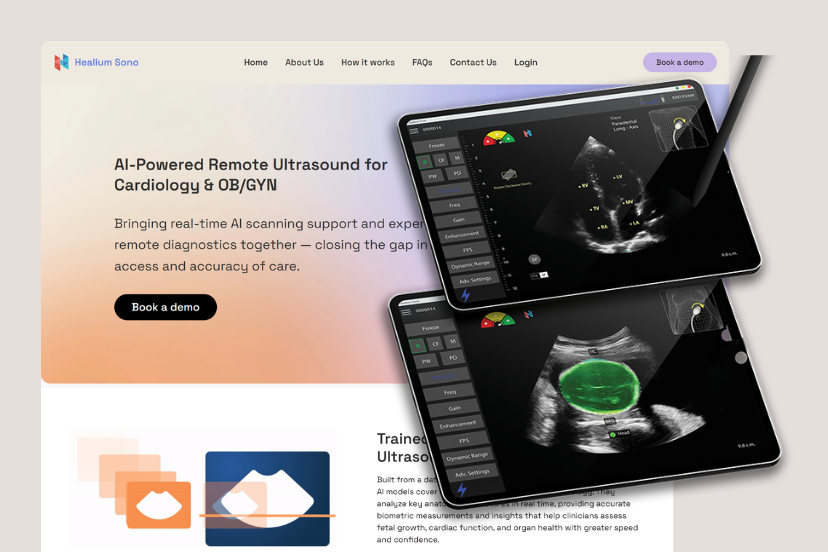
Added specialist escalation path integrated with Healium Sono teleguidance.
The Stack
Beyond The Headline Metrics
System analyzed over 5,000 ultrasound images within the first 6 months of deployment.
94% of AI-flagged cases were confirmed as CKD by nephrologist review.
Average upload-to-report time stabilized at 3 seconds, including network latency.
Identified over 200 early-stage CKD cases that standard clinical workflows would likely have missed.