Case Study 01 · Healthcare AI
Visit Live SiteHealium Sono
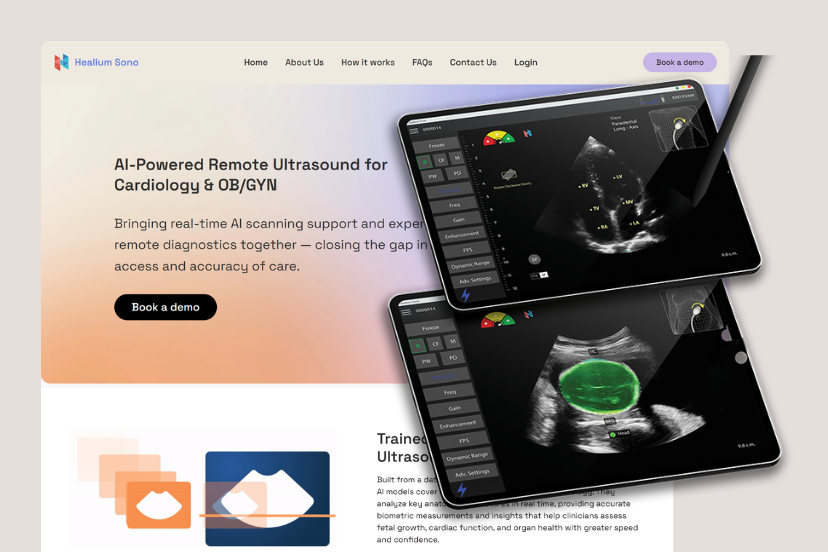
AI-powered remote ultrasound and teleguidance for cardiology and OB/GYN
Intro
Client: Healium Intelliscan Corporation
Industry: HealthTech / Telemedicine
Location: United States
Role: Lead Full-stack engineer responsible for architecture, AI service integration, real-time video, and deployment.
What Made This a Good Bet
Specialist cardiologists and OB/GYN physicians are concentrated in urban centers, while rural clinics often have ultrasound hardware but no real-time interpretation expertise.
Patient transfer and delayed referral increased clinical risk and operational costs.
The platform required remote specialist guidance in real time, with AI-assisted analysis running in parallel.
Misread or delayed OB/GYN ultrasound can lead to missed fetal abnormalities or undetected high-risk pregnancies.
Cardiology patients in low-resource settings often waited days for specialist review, delaying life-saving interventions.
Traditional teleconsultation tools offered video, but lacked a specialized guidance layer or AI decision support.
The target market included dozens of rural clinics with no on-site specialist access.
What I Built
Built a full teleguidance workflow with encrypted low-latency specialist sessions.
Integrated Zoom Video SDK for specialist-tech collaboration with live annotation and voice instruction.
Created an AI inference pipeline with FastAPI on AWS Lambda for structured ultrasound findings.
Implemented secure storage and clinic-level data isolation with Supabase Row-Level Security.
Solved timestamp drift and unstable network handling with session recovery and adaptive quality.
The Stack
Compliance & Data Security
Patient data encrypted at rest and in transit (TLS 1.3 + AES-256).
Compliance standards met: HIPAA and local health data regulations.
Audit logging: All specialist actions and session modifications logged for clinical accountability.
Beyond The Headline Metrics
Remote specialists guided 1,200 sessions across 45 clinics in the first year.
Average scan-to-specialist finding time reduced from 48 hours to 15 minutes.
92% of flagged cases were confirmed by subsequent specialist review.
Physician feedback indicates high reliability in low-bandwidth rural environments.