Case Study 09 · Healthcare AI & Systems
First Aid RAG AI
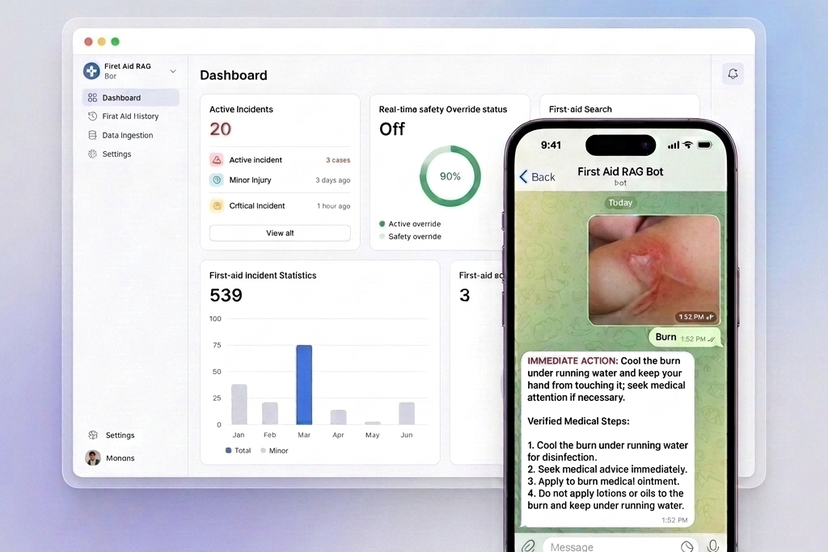
A safety-critical decision-support first aid bot with multimodal symptoms triage and automated safety gates
Intro
Product: Safety-critical conversational first-aid assistant, live on Telegram.
Industry: Digital Health / Emergency Medicine
Target market: Bystanders, caregivers, and rural users seeking immediate, verified first-aid guidance.
Role: Lead AI & Systems Architect (LangGraph design, RAG pipeline, vision triage, safety layers, and evaluation engineering).
What Made This a Good Bet
Traditional RAG pipelines can hallucinate or alter medical steps, which in an emergency could lead to injury or death.
Visual symptom inputs (photos of wounds, burns, rashes) suffer from high hallucination rates and diagnostic errors if processed directly.
Under time-sensitive stress, typical AI responses bury critical instructions under conversational preamble or background context.
Unvetted medical guidelines are a severe legal and health risk; procedures must remain completely unchanged from official manuals.
First aid is highly time-sensitive; delays or incorrect procedures (like wrong depth in CPR or inducing vomiting for the wrong poison) lead directly to fatalities.
A single hallucinated or misclassified scenario can bypass emergency services escalation when dispatch is vital.
To build trust with healthcare advisors, every piece of advice must be traceable to a certified medical professional with strict compliance auditing.
What I Built
Architected a LangGraph workspace partitioning context retrieval, visual symptom parsing, safety thresholding, and state persistence.
Designed a deterministic response formatter that enforces the immediate-action-first ordering contract in code, bypassing LLM output order.
Built a multimodal vision symptom extractor to describe injuries (burns, rashes, bleeding) and search scenarios using textual descriptions rather than direct visual diagnosis.
Implemented a rule-based safety layer that reads retrieved scenario metadata and checks text for danger indicators, triggering overrides independent of the LLM.
Created a Qdrant-backed historical correction system that matches user symptoms against past diagnostic errors to prevent regression.
The Stack
Beyond The Headline Metrics
Achieved 100% recall on the evaluation set for critical cases requiring emergency service dispatch.
Eliminated AI paraphrasing of critical first-aid steps entirely, enforcing 100% verbatim integrity.
Optimized full execution flow (including multimodal vision prompts and vector retrieval) to under 2.5 seconds.
Integrated historical corrections in the prompt system to resolve all regression vectors identified in clinical reviews.